

The Night Joe Went Missing
A Story About Men’s Mental Health and Why Men Suffer in Silence Men’s mental health is not loud. It doesn’t announce itself. It shows up as absence. As “I’m fine.” As a chair that stays empty. This is a story about emotional suppression in men, the pressure to perform strength, and the moment a man finally stops carrying everything alone.
Brotherhood Protocol Team
1/24/20263 min read
Most men don’t talk about anxiety, burnout, or the feeling of not being enough.They learn to stay useful. Stay strong. Stay quiet. That’s how silence becomes a habit.
Why Men Suffer in Silence
The bar is warm, low light, the kind of place where work boots and tired shoulders finally relax. Tools are down. One beer. Ten minutes together before everyone goes home. A ritual since day one. Alex scans the table. One chair is empty. Joe’s.
“Where’s Joe?” Alex asks. Mark, who has been there since the company was just an idea and a handshake, answers without looking up.
“He had something urgent. Left early. Didn’t even say bye.” That wasn’t like Joe. No joke. No delay. No “see you tomorrow.” Just gone.
Alex stays quiet for a second longer than usual, eyes resting on the empty space like it might explain itself.
The Field and the Call
Leadership in men’s mental health often starts before words.
It starts with noticing what’s missing. The next morning, the construction field is still half asleep. Cold air. Dust. The first coffee of the day. Engines warming up in the distance. Alex stands near a stack of steel beams when he sees Joe walking toward him across the gravel. Fast steps. Shoulders slightly forward. The walk of someone who doesn’t know why he was called, but already feels it’s not casual.
“You left early yesterday,” Alex says.
Joe gives a quick smile. Automatic.
“Yeah. Had something to take care of.”
“Your beer’s still waiting for you. Tonight you owe me two.”
A short breath escapes Joe.
“Yeah… sure.”
Silence settles between them.
“You good?” Alex asks.
“I’m good.”
The words come too fast. Joe blinks. His throat moves. One tear slips out before he can stop it, tracing his cheek like it took the wrong exit.
Alex turns toward the office.
“Come.”
“I’m Fine.” The Sentence That Breaks Men
Anxiety, burnout, and depression in men often hide behind one sentence.
“I’m fine.”
The office is quiet. Light through the window. A half-empty coffee on the desk. Alex closes the door. The click is firm.
“Sit.”
Joe sits. Hands on his knees. Fingers pressing like they’re trying to hold something in place.
“I don’t know what’s wrong with me,” he says.
“I work. I show up. I do everything right. But it’s like… it’s never enough. Everyone looks solid. Like they know where they’re going. And I just feel… behind. Like I’m pretending and one day it’ll show.”
A breath.
“I tell myself to shut up. To stop thinking. To be a man.”
His jaw tightens. The room feels smaller. Alex doesn’t interrupt.
Toxic Masculinity vs Modern Masculinity
Toxic masculinity teaches men to perform strength.
Modern masculinity teaches men to build it.
Alex walks to the bookshelf and comes back with a thin book. Thirty pages. He places it on the desk.
“Someone gave me this years ago,” he says. “On a day I was saying the same things.”
Joe looks at the cover, then back up.
“You think everyone here is stronger because they carry more,” Alex continues.
“They do. And most of them carry it the same way you tried to last night. Alone. Silent. Smiling.”
A pause.
“We were taught that’s what being a man looks like.”
He taps the book once.
“It’s not strength. It’s good acting.”
Joe’s shoulders drop a fraction, like something finally loosened.
“You didn’t fall apart today,” Alex says.
“You stopped acting.”
Strength, Discipline, Direction
Real emotional resilience in men doesn’t look loud.
It looks grounded.
Joe stands and takes the book, at the door, he stops.
“Do you really think I can become more than this?”
Alex looks at him with a proud smile.
“You already are. You just said the one sentence most men run from.”
Joe nods once and steps out. His back is straighter than when he walked in.
Not rigid. Anchored. Like someone who finally put something down.
This is Modern Masculinity.
Not silence. Not performance.
But Strength. Discipline. Direction.
“If you recognized yourself in Joe, start here: Modern Masculinity — a 30-page guide + free 30-day challenge.”
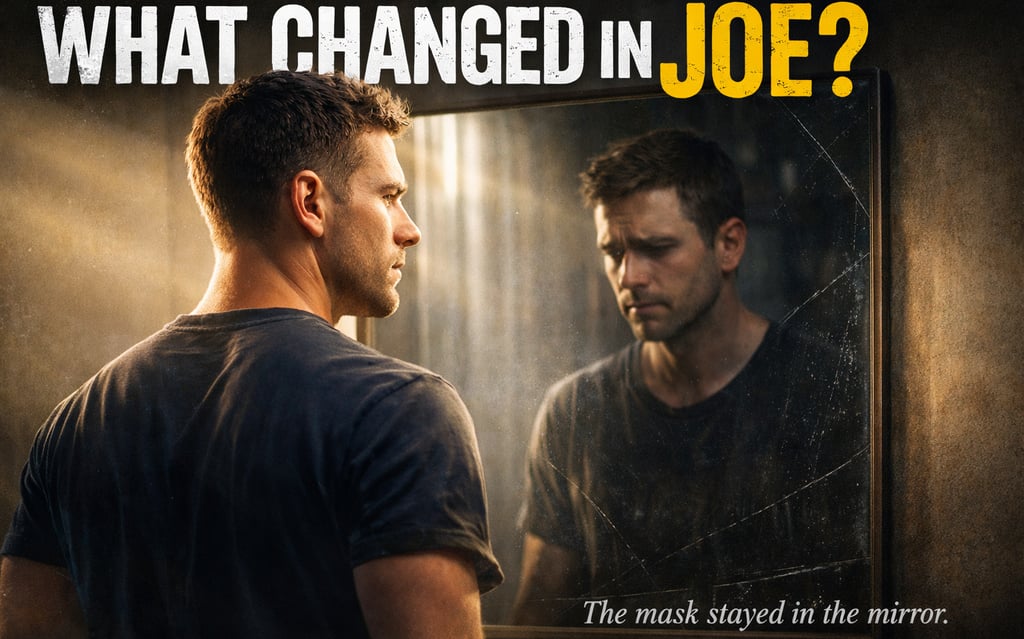
What Changed in Joe? mirror scene about men’s mental health and modern masculinity.
Modern Masculinity: Strength, Discipline, Direction
“Read next”
Quick links
© 2025 Brotherhood Protocol. All rights reserved.


Brotherhood Protocol is a modern masculinity platform dedicated to helping men build discipline, emotional resilience, self-respect, and direction in life. We focus on replacing toxic masculinity with structure, clarity, and inner strength so men can lead their lives instead of performing them.
Get exclusive content and offers straight to your inbox
Brotherhood Protocol
subscribe for updates